
SOLANA ONCHAIN OBJECTS / THE COLLECTOR’S GUIDE
An identity worth keeping.
Each active object has a serial, an owner and one whole collection token held behind it. Transfer the object intact, or retire it to unlock the token.
These rules apply to token-backed collections. Graduation reward collections do not lock tokens and follow a different issuance model.
Read the graduation reward model →
Genesis, OG and the generations after.
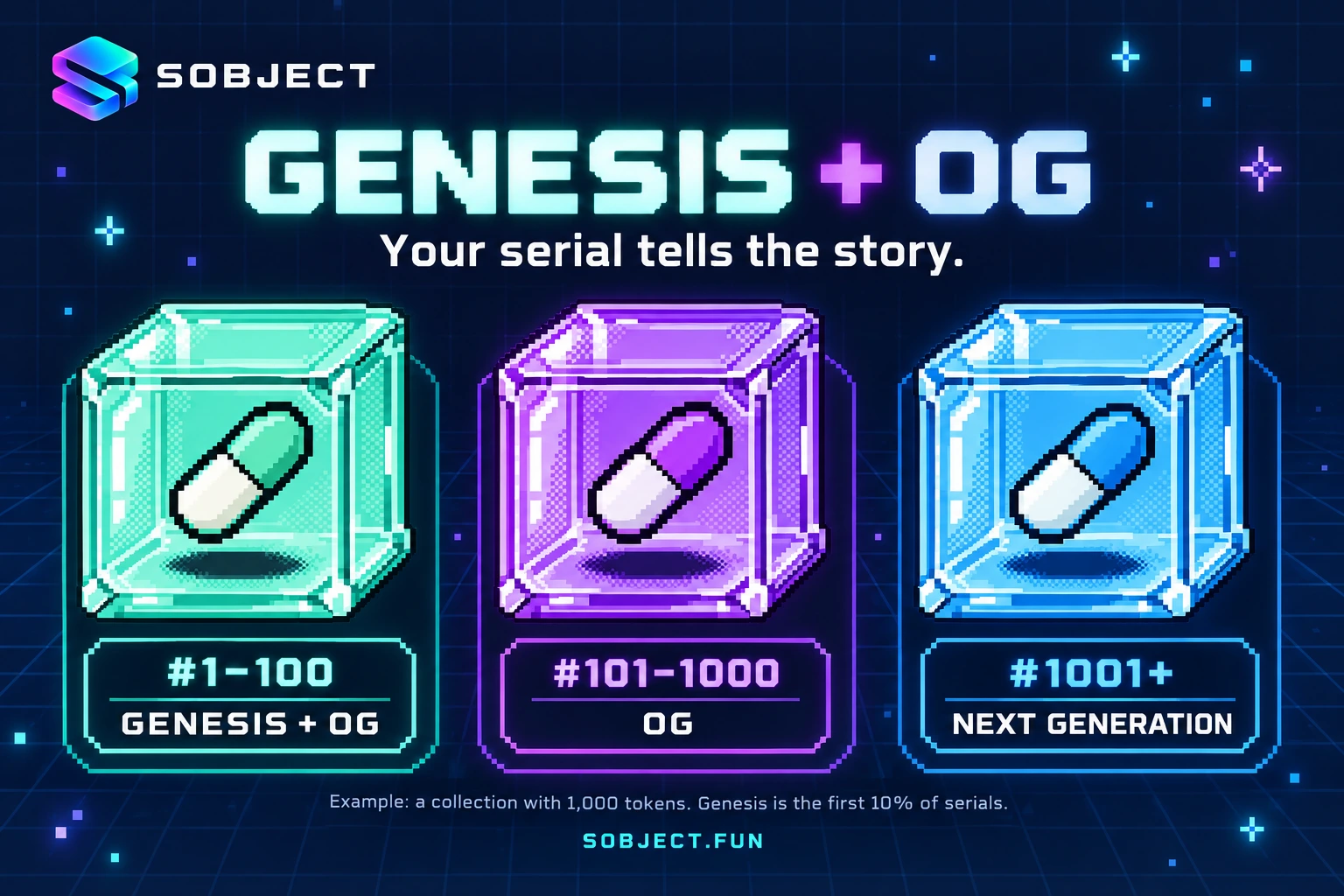
The first supply-sized generation is OG. Its first 100 serials also carry Genesis status, or the entire first generation if the supply is smaller than 100 tokens.
- #1–100: Genesis + OG. Gold provenance frames in the current renderer.
- #101–1000: OG. The rest of Generation 1, with cyan frames.
- #1001–2000: Generation 2. Later-generation frame colors derive from DNA.
- Every further 1,000 serials: the next generation, for this 1,000-token example.
generation = floor((serial - 1) / generation_size) + 1
OG         = generation == 1
Genesis    = serial <= min(100, generation_size)
Creation assigns the serial. Trading volume, token purchases before activation, wallet age and holding duration do not. Transferring or selling an existing object preserves its generation. One wallet can create several objects; Genesis is not a count of unique people.
Later generations do not dilute token supply. The program caps active objects at the collection’s whole-token supply and checks vault backing. Retired serials remain in history, so lifetime issuance can exceed the number of simultaneously active objects.
Creating again cannot bring back a retired serial. A new serial can still be Genesis or OG while its respective range is not yet exhausted. Generation frames mark provenance, not a promised monetary value.
From a liquid token to your object.
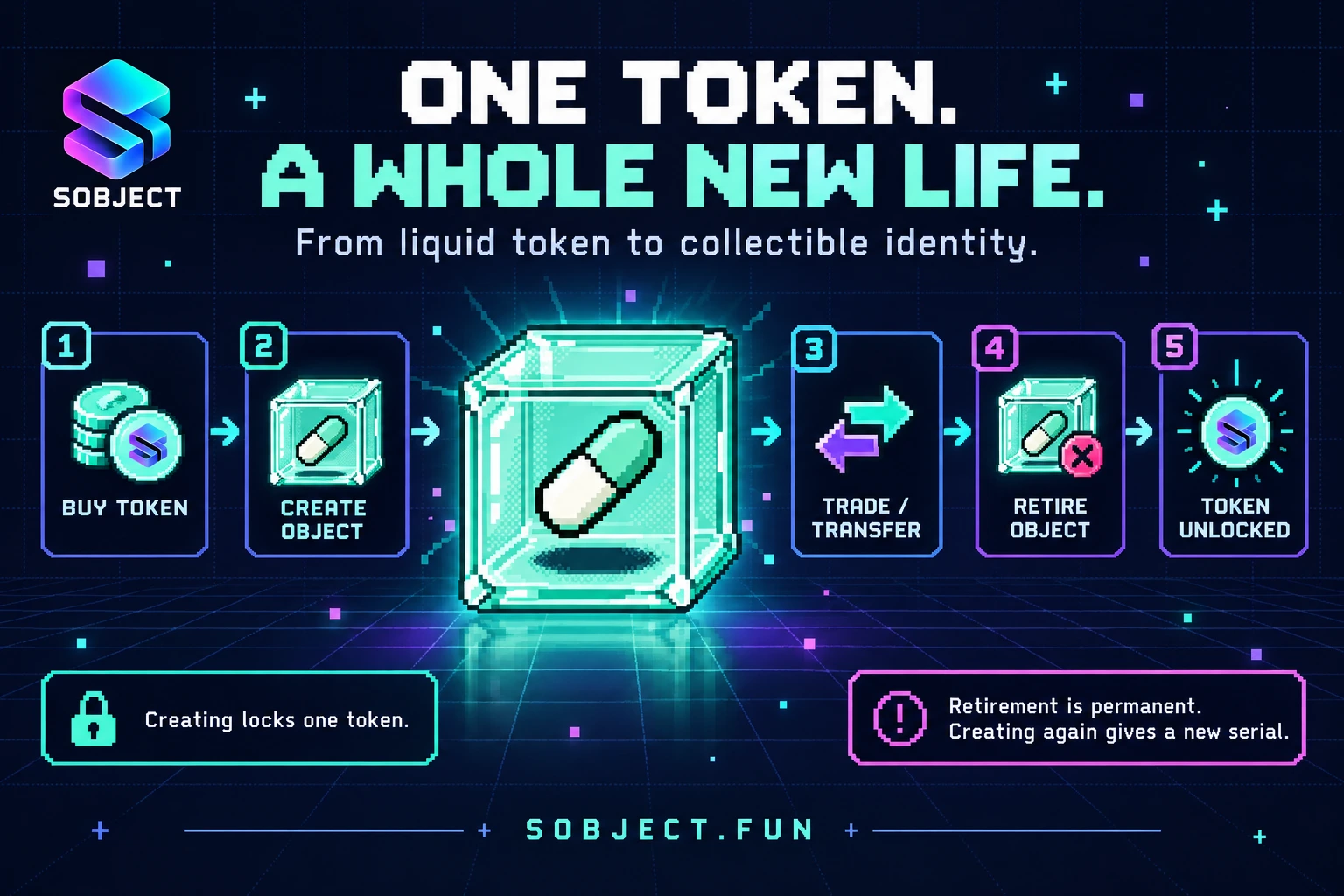
New launches activate their object registry in the launch transaction. The SOBJECT buy flow automatically creates objects from the whole-token output of the purchase. The fractional remainder stays liquid. Tokens bought through external venues can be converted later using the current serial queue.
You can also create objects from tokens already in your wallet through My Objects. A transaction can create up to 1,000 objects, subject to your token balance, active-object capacity and transaction limits. An old purchase uses the queue position at creation, not its purchase date.
The begin and finish instructions execute in the same transaction and check the expected next serial. A changed queue is rejected instead of silently assigning a different allocation. Storage rent is separate from the token amount and network fees.
Three states. Clear ownership.
- Active: the owner can transfer, list or retire the object. One token remains locked.
- Listed: the owner retains the object while offering it at a fixed SOL price. Cancel the listing before a direct transfer or retirement. The token stays locked.
- Retired: the backing token has been released. The record remains historical and grants no active ownership rights.
Initial ownership can live in the creation batch. When a separate record is needed, materialization creates it for that same serial and initial owner; it does not issue a new object or change its generation.
Use the SOBJECT transfer action to send an object. Sending liquid Token-2022 tokens through an ordinary wallet does not send any object. These records are not standard wallet NFTs.
Trade the exact character.
P2P Market listings name an exact serial and a SOL price. A purchase transfers payment and ownership atomically, preserving DNA, pixels and generation. The program checks price and listing revision to reject stale offers.
The current P2P program takes no platform fee. Solana transaction fees and any account creation rent still apply. These trades have their own history; they are separate from Meteora token-swap volume.
Unlocking is a one-way decision.
Unlocking returns one liquid collection token and permanently retires the selected object. It does not return the SOL originally spent, guarantee a sale price or restore that serial on a later creation. The artwork and historical identity remain reproducible.
Sell to pool adds a Meteora sale after retirement in the same transaction. A failed swap rolls the whole transaction back and preserves the object. The quote’s minimum output still applies.
Verify current rights onchain.
Use Verify on an object detail page for the permanent-object proof. It includes the mint, serial, owner, DNA, generation, Genesis flag, status, renderer version and slot. Checking a proof is a read; it does not move the object.
For token-gated access, authenticate the wallet with a fresh signed challenge or require its onchain signature, then validate a fresh program-owned proof. Active and listed objects can qualify. Retired records cannot, even though they still contain a historical owner. An address or screenshot alone is insufficient.
Identity and account reference
DNA = SHA256("SOBJECT_OBJECT_V2" || art || mint || serial_u64_LE)

Core program PDA seeds:
registry  ["objects-v2", mint]
vault     ["object-vault", mint]
batch     ["object-batch", registry, initial_owner, nonce_16_bytes]
object    ["object", registry, serial_u64_LE]

Proof: verify_collectible(serial)
HD pixels: render_collectible_tile(serial, x, y, width, height)
Status: 0 = active; 1 = listed; 2 = retired
The owner is not a DNA input. The artwork account, mint and serial are. Distinct serials can share a base character; identity does not imply every image is visually unique.
Ownership survives graduation.
DBC graduation and migration to DAMM v2 leave the object registry and backing vault in place. The same serial keeps its owner, DNA, artwork and generation. Transfers, P2P sales, verification and retirement continue through SOBJECT core after bonding. A new object created from tokens bought on DAMM v2 uses the current serial queue.
This continuity does not rely on an active transfer hook. Ordinary token transfers still move only liquid tokens. Use the object transfer action to send a particular character. Read how we handle the post-bonding transition →
Collection activation and artwork.
Launching activates the collection registry and records its fixed generation size. Object creation begins at serial 1. Token purchases alone do not reserve a place in the object queue; check the current next serial before creating.
The current program prevents editing or closing bound artwork through its normal instructions. The program remains upgradeable; permanent serial identity is not a claim that its upgrade authority has been removed.